 Free shipping: Ireland orders over €60

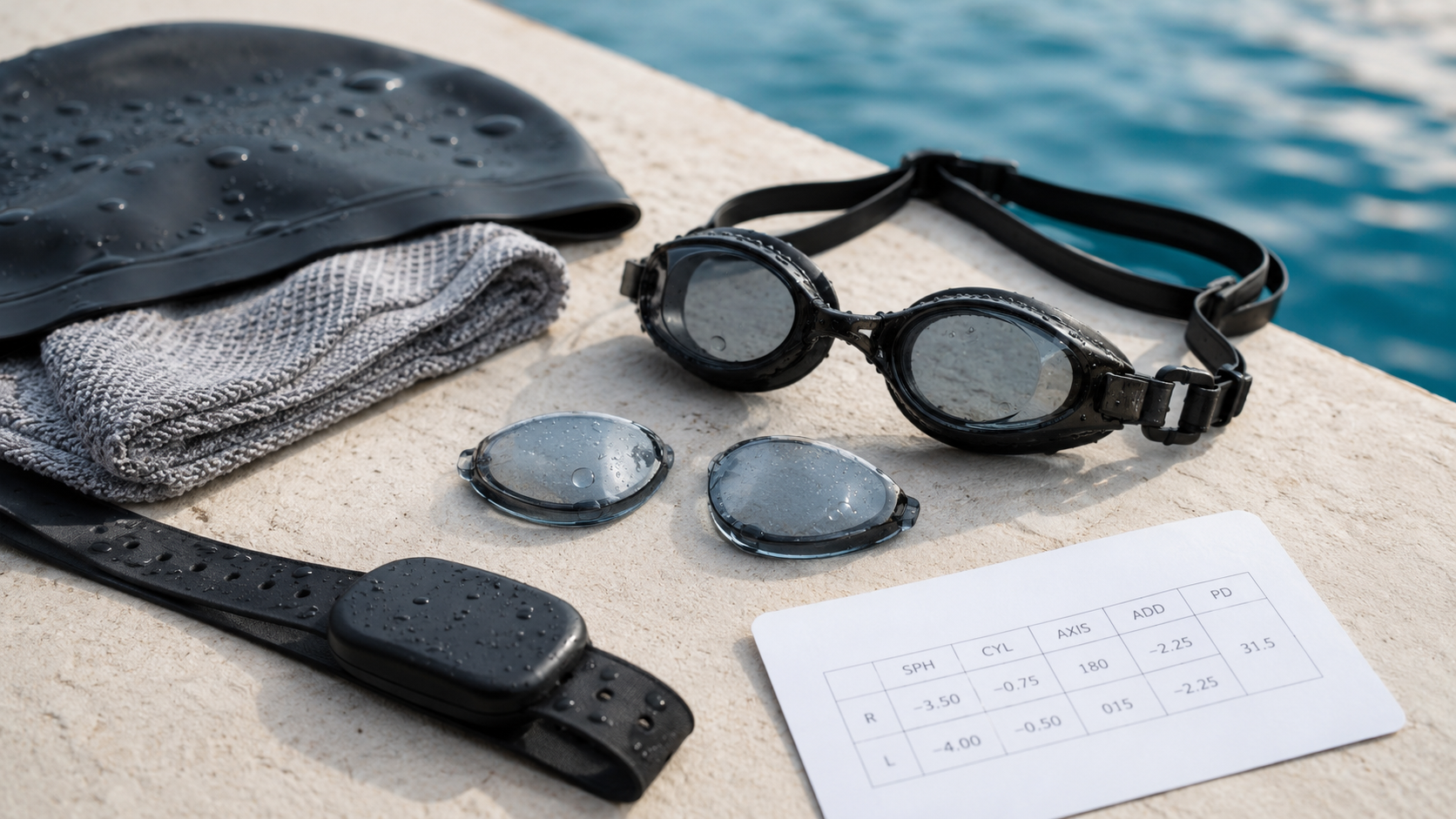
If you wear glasses or contact lenses, the open-water swim can turn a simple race-day question into a real confidence issue: can you see the buoy, the swimmer beside you, the exit arch, and your bike rack clearly enough?
For many triathletes, prescription swim goggles are the cleaner solution. They are not medical treatment, and they will not perfectly replicate your glasses, but they can make open-water navigation much easier while reducing the need to swim in contact lenses.
This guide explains how prescription swim goggle lenses work, how to estimate diopter strength, when to ask an optometrist, and how to build a practical race-day setup.
Why prescription goggles matter in triathlon
Pool swimmers can often get away with a little blur. In triathlon, the demands are different. You need to sight buoys, judge other swimmers, spot the swim exit, move through transition, and stay calm in changing light.
That is why prescription goggles are less about perfect optical sharpness and more about functional race vision. The goal is simple: enough clarity to swim straight, avoid panic, and move through race morning without juggling glasses at the water's edge.
Contacts in open water: why the risk is worth taking seriously
The main reason to consider prescription goggles is not speed. It is eye safety and practicality.
The CDC advises contact lens wearers to keep lenses away from water and remove them before swimming or showering to reduce exposure to germs and infection risk. That advice matters for pool, lake, river, and sea swimming because water can carry microorganisms that become more problematic when trapped against the eye by a contact lens.
Some athletes still race in contacts under tight goggles, especially when they do not have a practical alternative. If you do, speak with your eye-care professional and be disciplined about hygiene, daily disposables if recommended, and not removing or rinsing lenses around race water. For many short-sighted swimmers, prescription goggles are the simpler option.
How prescription swim goggle diopters work
Most ready-made prescription swim lenses use spherical diopter steps, usually in half-diopter increments. That means they correct the main near-sighted or far-sighted part of the prescription, but they usually do not correct astigmatism in the same way your glasses do.
A common estimate is the spherical equivalent:
Sphere + half of Cylinder = estimated diopter strength
For example, if one eye is SPH -3.00 and CYL -1.00, the estimate is -3.50. If the calculated number falls between available lenses, many goggle guides suggest choosing the slightly weaker option rather than over-correcting. That said, prescriptions vary, astigmatism matters, and your optometrist is the right person to confirm what is sensible for your eyes.
When to ask an optometrist before buying
Ask for professional help if your prescription is old, if your two eyes are very different, if you have meaningful astigmatism, if you use multifocal or complex lenses, or if you have any eye-health condition. Prescription goggles are a practical training and racing tool, not a substitute for eye care.
You should also test the setup before race day. A lens that feels fine when standing still may feel too strong, too weak, or visually odd once you are swimming, sighting, and breathing bilaterally.
Fit first, prescription second
The best diopter choice will not help if the goggle leaks. For triathlon, fit is the first test.
Use this quick fit checklist
- Press the goggles gently to your face without the strap. They should hold suction for a moment.
- Check that the gasket seals without needing the strap painfully tight.
- Test head movement, sighting, and breathing in the pool before open water.
- Try them with your race cap and, if relevant, under your wetsuit collar position.
- Pack a backup pair, even if it is a non-prescription emergency pair.
Open-water lens choice still matters
Prescription strength is only one part of the decision. Open water adds glare, chop, low sun, overcast starts, and changing visibility.
For bright race mornings, mirrored or darker lenses can reduce glare. For overcast or shaded starts, lighter lenses may make buoys and swimmers easier to pick out. U.S. Masters Swimming notes that mirrored and polarized options can help with glare, but darker lenses may be less useful in low light. That is why many triathletes keep two race-tested options when possible: one brighter-condition setup and one clearer or lighter setup.
Product setup: HUUB Altair prescription lens system
Endurance Lab stocks the HUUB Altair Swim Goggle, an interchangeable-lens race goggle for pool, open-water, and triathlon use. For athletes who need correction, the HUUB Altair Prescription Lens lets you build left and right lens choices for compatible Altair goggles.
The practical advantage is that many athletes do not have identical prescriptions in both eyes. A modular left/right lens setup can be more useful than a one-strength pair, especially if you want one eye slightly different from the other. Check availability by side and diopter before race week, and test the exact setup in training.
You can also browse the full Swim Goggles collection or HUUB options in the HUUB collection.
Race-week setup checklist
- Confirm your current glasses prescription before choosing lens strength.
- Use spherical equivalent only as a starting estimate, not a diagnosis.
- Test the goggles for leaks across several pool sessions.
- Do at least one open-water practice if your race allows it.
- Practise sighting with the actual lens tint you plan to race in.
- Bring anti-fog backup and a spare pair on race morning.
- Keep glasses accessible in transition if you need them after the swim.
FAQ
Can I wear contact lenses under swim goggles?
Some athletes do, but public-health guidance is cautious because contact lenses and water exposure increase infection risk. The CDC advises removing lenses before swimming. If you feel you have no alternative, ask your eye-care professional how to reduce risk.
Will prescription swim goggles match my glasses exactly?
Usually not. Most ready-made swim lenses use step diopters and do not fully correct astigmatism. The aim is usable swimming vision, not perfect everyday vision.
Should I choose the same diopter for both eyes?
Only if your prescription is similar in both eyes. If each eye needs different correction, a modular system such as the HUUB Altair prescription lens setup may be more practical.
Are prescription goggles worth it for a first triathlon?
If poor vision makes you anxious, affects sighting, or means you would otherwise swim in contacts, they are worth testing early. The key phrase is testing early: never use new goggles for the first time on race morning.
Bottom line
Prescription swim goggles are a practical race-day confidence tool for triathletes who need vision correction. Choose fit first, use your prescription carefully, ask an optometrist when anything is unclear, and test the exact setup before open water.
Need a modular setup? Start with the HUUB Altair Swim Goggle, then match compatible HUUB Altair Prescription Lenses by side and diopter.
Research notes and sources
- CDC: Preventing Eye Infections When Wearing Contacts - contact lens hygiene and advice to remove lenses before swimming or showering.
- NCBI Bookshelf / StatPearls: The Spherical Equivalent - formula and clinical context for spherical equivalent correction.
- Eyes On Eyecare: Prescription Swim Goggles Guide - optometry-oriented discussion of spherical equivalent and prescription swim goggle limitations.
- U.S. Masters Swimming: Mirrored or Polarized Goggles for Open Water - practical open-water lens and glare considerations.